Sunday, March 2, 2014

Cuckoo Clocks!

So, thanks to a documentary in my German class, I've discovered a little novelty with German origins.

The cuckoo clock.
Source: http://www.cuckooclocks.com/get-image.aspx?file=1-0260-01-c.jpg
Isn't it so cute?
Short history: The cuckoo clock from the Black Forest--Schwarzwald. The very first (primitive) cuckoo clock was made in around 1630. Eventually, clockmaking became a popular trade among the farmers of the Schwarzwald. When the winters were cold and the farms were covered in snow, what did they do?
Source: http://upload.wikimedia.org/wikipedia/commons/e/e8/Clockmakers_black_forest.jpg

They made clocks. 

These days, cuckoo clocks are made with astonishing details--along with the rhythmic cuckoo chime that sounds off the hours, there can also be waltzing figures, miniature soldiers that move their limbs, and beautiful, intricate design and setting. 

The BEAUTIFUL CLOCKS
Source: http://www.cuckoo-palace.com/cuckoo-clocks-blog/wp-content/uploads/2012/10/Schwer_17.10-225x300.jpg


The inside is no less fascinating than the outside--all the gears, wires and dials fit in this one boxlike structure called the movement, which is the heart of the clock--and the timekeeper. Cuckoo bellows are fit snugly on top of the movement, and are connected by wires and a pendulum that sets the movement in motion. 

Left: a cuckoo clock, and right: the movement
Source: http://public.media.smithsonianmag.com/legacy_blog/early-cuckoo-clock.jpg

Here's an incredibly interesting and informative 5-minute video on cuckoo clockmaking. 


To this day, cuckoo clocks are still a long-standing tradition in the Black Forest. Many of them are still family businesses that create wooden masterpieces that are not only excellent timekeepers, but a marvel and a work of art.

Sources:
http://www.youtube.com/watch?v=57NTH-v2GXU --the video above
http://www.cuckooclockworld.com/history.htm

Monday, February 17, 2014

A Day in the Life: Breakfast in Germany

Traditionally, breakfast in Germany has been a very diverse, hearty meal with many dishes. In today's world, where people opt for a quicker lifestyle, breakfast is more simplistic; however, food is a rich culture in Germany and breakfast is an important meal of the day.

A traditional German breakfast would have:

Bread:

Source: https://encrypted-tbn3.gstatic.com/images?q=tbn:ANd9GcRehHRjXECATya2wi0HEJRvMNB8ideoSGN781kH8WMW1tP3HtEaPA
The German are big on their bread, and it is usually a base staple for their meals. Their bread, cut from loaves or served in rolls, is often bought fresh from a local bakery.

Spreads:
Source: http://www.thewednesdaychef.com/.a/6a00d8341c660253ef017eea4212c4970d-pi
A choice of jam, butter, or a cheese known as quark. 

Beverage:
Source:http://liebesgermany.files.wordpress.com/2013/01/germanbreakfast2.jpg%3Fw%3D637%26h%3D424

Usually coffee or tea is served, sometimes it is a glass of juice, or milk. (note: unlike in America, where coffee is taken in mugs, coffee in Europe is usually taken in teacups, or what I like to tall "espresso cups")

Cold cuts or wurst:
Source: http://stockarch.com/files/13/08/meat_and_cheese.jpg

A German meal just isn't German if it doesn't have its sausage.

Eggs:
Source: http://img.food.com/img/recipes/27/82/30/large/picjABRsr.jpg

So that's it: a delicious, hearty German breakfast! Now, I know that the typical German does not eat such a splendid breakfast like this every day, (just like Americans don't eat pancakes and bacon every day) but it sure would be nice to have a traditional German breakfast like this every once in a while, wouldn't it?

Sources: http://www.germanfoods.org/consumer/facts/eatinghabits.cfm
http://livingingermany.geekymoms.com/2013/05/31/traditional-german-breakfast/

History: the skiing warfare of WWII

So, coming off of the current Winter Olympics excitement and Germany's victory team gold in men's skiing...I thought I might focus on Germany and skiing.

Germany, Austria, and Switzerland have had a long history in skiing. The Alps along their southern border provide one of the world's most prominent skiing bases, and kids often begin skiing while they are very young.

But...did you know that there was such a thing as skiing warfare? 

I didn't.

Dating back to the 1600s, ski warfare has been used in many parts of Europe, from the battle in Polish-Lithuania against Russia in 1605 to the Norwegian-Swedish war of 1814 to WWI Austria to WWII Germany.

Look! The Swedish!
Source: http://www.theskichannel.com/wp-content/uploads/2009/08/20090807_Norwegian_ski_soldiers_606.jpg 
Because many parts of Europe are mountainous, especially central Europe, fighting is not always done on open terrain. In World War II, the US formed the 10th Mountain Division and took to the dangerous terrain of the Alps, where some German troops were situated.

According to a source on npr.org: "The men lived in the mountains for weeks, working in altitudes of up to 13,500 feet, in five to six feet of snow and in temperatures that dropped to 20 degrees below zero at night."

Around that time, "Ski tanks" were developed to access the snowy sites of battle:
Ski tanks
Source: http://www.theskichannel.com/wp-content/uploads/2009/08/20090807_aerosan.jpg


I'll admit, there isn't too much rich historical background behind ski warfare, but the thought of soldiers fighting in skis was quite interesting, and something I had never encountered before:

Sources: http://www.theskichannel.com/news/20090807/guns-blood-skis-the-history-of-ski-warfare/
http://www.npr.org/templates/story/story.php?storyId=14594652

Thursday, January 16, 2014

Little Discoveries

I used to learn Spanish.

The proudest moment of my Spanish-learning endeavor was not getting good grades, or figuring out elusive extra credit questions. It was not the time I got an 100 on a test.

Last year, I went to China over spring break. The best part of it wasn't climbing the Great Wall or visiting the striking palaces or even the food.

It was the moment, on a crowded, busy Beijing street, by a vendor selling fried scorpions on a stick--in a span of five minutes, I spoke three languages at once. I conversed with the vendor and translated for tourists from Spain, and in that moment in time, I switched between the three languages I knew in varying degrees of fluency almost effortlessly.

(I also tried to dissuade the tourists from buying said scorpions on a stick, but sadly, the didn't heed me.)

That was an aha moment for me. I was a little bit sick and weak that day, but I remember emerging from that street, my cheeks glowing. The fact that I COULD use the things that were taught me in class--and in such a natural way--it made me love languages even more.

This fall, even though I switched from Spanish to German, at a park district center, I picked up a copy of a Spanish newspaper--and discovered that I could read it.

That, also, was a groundbreaking moment for me.

As I am learning German, I try to do well in class, but my teacher is also very, very good at combining culture and colloquies with grammar and conjugation. Little by little, I get the full experience of Germany and its culture.

The discoveries have spiked up my life in little ways. Reading a tweet in German and suddenly figuring out that the word "gewinnt" meant "win" in past tense.  Being at a debate tournament and discovering that one of the opponents' last name was Silber--meaning silver in German.

Realizing that German isn't quite the guttural, throaty language I had perceived it to be, but actually something that sounded smooth and sweet and concise.

These little discoveries are my proudest moments.


Saturday, January 11, 2014

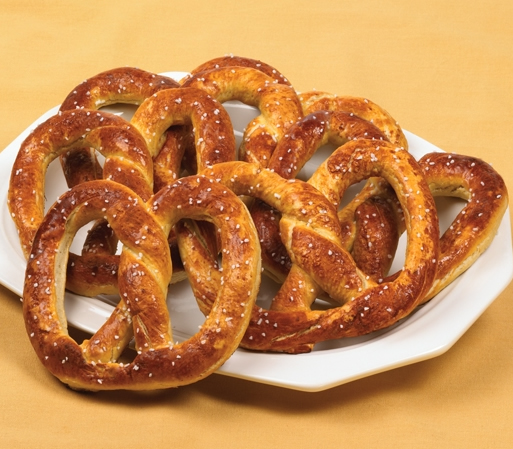
The German Pretzel

You know what I'm talking about.

Those big, soft, chewy works of art, twisted into a rolls of doughy goodness.

Source: 


(I'm hungry.)

The German pretzel (Laugenbrezeln) has quite a long history, dating its prominent origins back to maybe the 12th century (some sources say it originated from an Italian monk in the 7th century). By the 17th century, the German pretzel was seen as a sort of religious food, usually consumed during the Lent/Easter time period. The three holes in the pretzel represented the Trinity (father, son, Holy Spirit), and during matrimony, the pretzel was thought to represent union and eternal love (hence the phrase, "tying the knot!")

The pretzel is one of the staple foods of Germany, and throughout many regions of Southern German (such as Bavaria), it can be eaten for breakfast or snack. During Oktoberfet, the pretzel is usually accompanied by fine German beer and weisswurst (white sausage).

It is traditionally made with flour, butter, yeast, and warm water. To give it the distinct crunch, some pretzels are also dipped in lye.

(I'm getting really, really hungry.)

*skips off to make my own pretzels*

Sources:
http://www.theoktoberfest.com/HTML/pretzel/
http://www.foodnetwork.com/recipes/alton-brown/homemade-soft-pretzels-recipe/index.html
http://www.bavarianpretzelfactory.com/history.html


Agnes Obel

I have a weird, incredibly picky music palate. My playlists are often 10-20 songs long, if that. When I like a song, I really, truly love it, and am willing to listen to it all day.

Which leads to the fact that I never really like an artist, only certain songs he/she has to offer.

But.

There has been maybe 3 exceptions to this case. And singer/pianist Agnes Obel is one of them.

This is my favorite song from her, Dorian. 


Agnes is 33 years old, originally from Denmark. But she has been living in Berlin since 2006. She has produced 2 albums, one called Philharmonics, and another newly released album called Aventine. Her works are inspired by Edgar Allen Poe, Alfred Hitchcock, Maurice Ravel, and Erik Satie.

I have just recently discovered her, but she seemed to be a bit of a European sensation, with both her albums hitting number one on the charts of Denmark, Belgium, Norway, and Germany.

Go on and listen. It's perfect for a rainy day.

Sunday, December 1, 2013

Movie: The Book Thief

So on Friday, I saw the movie for The Book Thief.

I read the book in 8th grade. It was part of the reading curriculum. Other than Animal Farm, it was the only book I loved.

The story is set in World War 2 Germany, narrated from the point of view of Death. It follows the story of Liesel, who is adopted by foster parents Hans and Rosa Hubermann and lives and grows up in a socialist world with many internal conflicts.

Hans is a tall gentle man that teaches Liesel to read and plays the accordion. Rosa is a sharp-tongued woman who has a soft heart inside. She swears and curses frequently and often, using the words saukerl and saumensch, meaning "filthy pig", and arschloch, meaning "asshole".

I was so afraid that the movie would underscore the book, because the book was beautiful on its own, and i was sure that the beautiful, witty language could not be transcribed onto screen.

I was wrong. I bawled. The entire time.

It makes me want to cry just thinking about it, because the movie was amazing all on its own.

There was Max Vandenburg, the German Jew that hid in the Hubermanns' basements for a time. Liesel made him want to survive and know what it was like to live, describing simple things such as the weather, or bringing a handful of snow. Max, on the other hand, encouraged her to read and to write and share the stories of her own. He says, (heavily paraphrased"...

"In our religion, we believe that every living thing, every leaf, every creature, every human, has a secret word that gives them life. it is what separates us from that lump of clay...Use it, Liesel. Words are the power we have." 

That is deep.

And then there was Rudy.


Rudy!!!!!

Rudy :'( :'( :( :(


He was the boy Liesel befriended, who played soccer and once painted himself black with charcoal to pretend to be Jesse Owens. He walked with her, he raced with her down the streets, and once, he tried to run away with her, with nothing but a three-piece suit on his back and a soccer ball in a rucksack. The first time he raced her down a snowy street, he bet her a kiss if he won. No spoilers, but I was laughing crying so, so hard in the scenes with Rudy, because he is adorable and impulsive, rebellious and funny.

So many feels.


The scenes that I imagined in my head while reading the book were shot so powerfully. Even in the scenes where there were no words spoken, there was a deep presence of the era, of a war-torn country and the people living in it. It wasn't a country full of brainwashed people--no, no, no. They were desperate, but they were still strong, still loving and stoic. It depicts that time period without judgement, and I was grateful for that.

In the end, there was this old couple in front of us that kissed, and hugged each other, which just...

The tears.

So watch it. Bring tissues.And read the book too, because it truly is one of the great contemporaries of this century.