Saturday, April 26, 2014

Southern Y'alls and New York Accents: the German Edition

We know about it here in the States. Down south are the wide Southern accents, the "y'alls" and the wide syllables. I live in Chicago, and a few months ago, at a debate tournament, people from Kentucky commented on my Chicago accent--the narrower words, the nasal tone. There's also the New York accent--the cute curl at the tip of each word, the soft, crisp edges of each sharp syllable.

It's the same in Germany, and in the German-speaking parts of Europe. One from northern Germany may not perfectly understand someone from southern Germany, and someone from east Germany may not understand another from Switzerland.

This video might offer a bit of insight into the different dialects:


Basically, there are three kinds of German spoken in Germany:
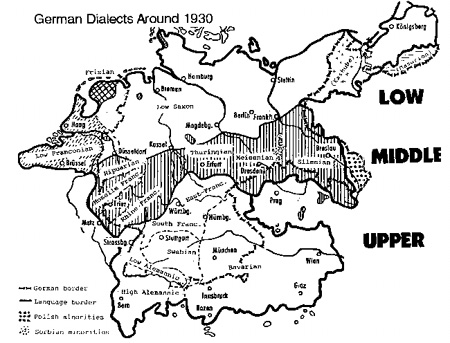
Source: Link

Source: Link

Hochdeutsch: Known as "High German", this is what is generally accepted as the standard German, and the German that is taught to foreigners. It is the language spoken in Southern Germany, around the Alps. Dialects include the Bavarian dialect and parts of the Austrian dialect. S consonants are pronounced like "sch" and Rs are rolled.

Mittledeutsch: Known as "Middle German", this is the dialect that is spoken in central German, around cities like Frankfurt, Cologne, or Dresden.

Niederdeutsch/Plattdeutsch: Known as "Low German", this dialect is usually spoken in northern Germany. (Though Berlin is included, the city is known to speak a form of Hochdeutsch or standard German). S consonants are pronounced like "ss-", instead of "sch-", and Rs may or may not be rolled. "Platt" here refers to the lowlands (which are flat), but I would assume that the dialect here also sounds slightly flatter than Hochdeutsch. Sometimes, the Plattdeutsch dialect has a connotation of being improper, but in most cases it refers to the dialect spoken in Northern Germany.


This interests me-here in the States, usually a Southern accent is noted as being "improper", while the way of speaking in the north is the standard "American English" taught to foreigners. Exactly the opposite of Germany! However, America is not very much known for its diversity of dialects--other than the prominent Southern dialects, the differences between the other American dialects are not quite noticeable. It's almost guaranteed that someone from opposite ends of the country would be able to understand each other perfectly. It also is quite interesting to see how clearly the dialect divides are lined; if only America could be so organized!


Thursday, March 27, 2014

Sometimes I wish I lived in Europe

It's not really a childlike wish as much as it is a contemplative thought.

What is America, you say? Ask any coy European and they have a list to playfully strike you down.

Fat. Cheerful. Overworked burnouts. Rude. Insensitive. Ignorant. Unorganized. Bland.

It's...true. And not.

When I think of culture, I think European before anything else. I think of castles older than my country. I think of sprawling museums with relics of the past, paintings that give a window into what life was long ago. I think impressive architecture, long histories and bloody feuds that sustained between infamous families.

My country doesn't have that kind of feel. America was created to be stripped of bias and tyranny. America is production, not preservation. Individual achievements over community benefit. Making the new, and tossing the old.

Culture? If diversity were a culture...

We are a melting pot. We identify ourselves with nothing that's the same but "American"--and in the loosest sense, it means that our strongest sense of pride is in that one word that our country is named after. That's our strongest link, but by no means a close, communal one.

Europeans have nations, but they also have traditions, and cultures that transcend national barriers. Regional bonds and familial traditions are tighter than any country label they have. Europeans are fond of preservation and history, dedicated to traditions.

Americans don't have an identity; they must make one for themselves.

Yes. Americans can be greedy and materialistic. Americans can be offensive. Americans can be the sweaty, exaggerated, fanny-pack travelers that they Europeans snicker at behind their backs. They may not be graceful explorers.

But keep in mind; next time you see an American huffing and puffing up the narrow stairs to the castletop, or squinting at a Louvre painting, or taking pictures after pictures of the rustic arches of the Roman forum, know that a part of them is trying to seek and capture a beautiful, tangible culture that they long for, but don't have.

Saturday, March 22, 2014

Mozart's Impact

I think there was that Seneca quote that went like, "Life is like a play; it's not the length, but the excellence of acting that matters."

I think that's especially true in the case of Wolfgang Amadeus Mozart.

I don't think this will be an incredibly informative post. It certainly won't be a scholarly analysis of his works, or on specific facts of his life.

Other than this one: he was a brilliant musician. He was a solid genius that managed to pack into his short 35 years of life what others can't attempt  to create in a century.

Mozart's K333 Sonata was the last piece I ever played at a piano competition, you know.

Other people may attempt to pound out his achievements. Because even though I was never good at music competition, I have a good sense for music, and personalities. I want to try to describe the character of Mozart--first, through other composers.

Beethoven (9th symphony) was tempestuous and explosive, Tchaikovsky (Swan Lake & Nutcracker) was illustrious, intricate, and ethereal and Prokofiev (Romeo and Juliet) was ponderous and heavy. Composers were constantly looking to make their "mark"--through a certain music style, or through a manner of composition execution or through their trademark nuances. They wanted a legacy--and being mad genisues, they wanted a dramatic legacy.

Mozart wasn't that.

Mozart is constant, comforting. His music, though not repetitive, certainly creates this straightforward sense of dependability that other music geniuses lack. His pieces have solid, melodies, with perfectly simple, mathematical rhythms that a child could count out. After he gained fame, he didn't succumb to it. He still created the same music he had all his life.

They are not hard to play. But the genius in Mozart's music isn't in the ability to play it. It's in the ability to understand it.

Behind the frills-free sonatas lie an inner musical working that is miraculous and bafflingly straight-laced. Each note has a symbolic meaning; each chord is meant to resonate a certain way.

I loved music, but I hated practicing. I didn't appreciate music until I quit piano a few months ago--and it was then that I realized that all the things my brilliant teacher said--all the meanings behind each embellishment and each --how they contributed to the whole of the creator--the composer.

In the end, Wolfgang Amadeus Mozart let his music speak for himself. In his short life, he still made an enormous legacy for himself.

Try it for yourself. Listen to the composers I listed above, and then listen to Mozart's K333 Sonata. You'll know what I mean.


Chocolate: Belgium vs. Switzerland

Source: http://kitchentalks.com/wp-content/uploads/2011/05/Kitchen-Talks-Swiss-Chocolate.jpg

If there's ONE thing that makes me want to go to central Europe (Germany, Switzerland, Austria, Belgium) more than anything, it's this: the chocolate.

I still remember that time my dad brought a tin of German/Swiss truffles back home. Let's just say that I claimed the box, and it was clean and empty within three days. 

Creamy, was what I thought. It was rich and smooth and velvet that melted on your tongue. There were subtle flavors; hazelnut layering on coffee-hinted dark with just a whiff of vanilla. The outer shells were marvelously crispy, while the insides were heaven to my taste buds. 

(If I'm making you salivate, then I've done my job.)

There's no question; they have the best chocolate in the world.

But what about the best of the best--Belgium and Switzerland? They have quite a chocolate rivalry, but they both boast of proud chocolate histories and special techniques that make the delicious confections taste so spectacular. 

Belgium: 

Taste: Belgian chocolate is known for its quality of the cocoa taste in the chocolate. The flavor is stronger, more brusque, but also more pure. 

Contributions: The Belgians invented the praline in 1912--a man named Jean Neuhaus was credited coming up with the idea that would change the face of the chocolate manufacturing. He would make a chocolate mold (the converteur), and add soft fillings such as cream, nougat, or toffee (there are different flavors--hazelnut is a popular choice.)

Switzerland:  

Taste: Swiss chocolate is known for its smooth, creamy taste--since Switzerland is credited for the invention of milk chocolate, it has perfected the soft texture that melts in your mouth. 

Contributions: The Swiss had many chocolate innovations, but the most important of them came from a man named Daniel Peter. Originally a candle-maker, he switched to chocolate when he was said to have been besotted with the daughter of a chocolate-maker. He began experimenting with chocolate, and eventually ended up with a product known as milk chocolate--something that is so common today that it is unfathomable that the Europeans back then had only dark chocolate to eat. 

Which is better, you ask? 

I don't know, actually. If I ever get to go to Switzerland and Belgium, I will definitely find out for myself. 

But regardless, chocolate is a food that is quite near and dear to my heart, and it's quite cool to learn how two countries dedicate themselves to the innovation of chocolate. To have each person constantly strive to improve the technique of production and the taste--that's what gives European businesses such credibility and uniqueness. Sometimes, when I think of Europe, I think of homey, family-run businesses and individual shops that counter the American mindset of mass-production and major chain industries that, at times, sacrifice identity and quality for convenience. 

Food for thought, isn't it?


Sunday, March 2, 2014

Cuckoo Clocks!

So, thanks to a documentary in my German class, I've discovered a little novelty with German origins.

The cuckoo clock.
Source: http://www.cuckooclocks.com/get-image.aspx?file=1-0260-01-c.jpg
Isn't it so cute?
Short history: The cuckoo clock from the Black Forest--Schwarzwald. The very first (primitive) cuckoo clock was made in around 1630. Eventually, clockmaking became a popular trade among the farmers of the Schwarzwald. When the winters were cold and the farms were covered in snow, what did they do?
Source: http://upload.wikimedia.org/wikipedia/commons/e/e8/Clockmakers_black_forest.jpg

They made clocks. 

These days, cuckoo clocks are made with astonishing details--along with the rhythmic cuckoo chime that sounds off the hours, there can also be waltzing figures, miniature soldiers that move their limbs, and beautiful, intricate design and setting. 

The BEAUTIFUL CLOCKS
Source: http://www.cuckoo-palace.com/cuckoo-clocks-blog/wp-content/uploads/2012/10/Schwer_17.10-225x300.jpg


The inside is no less fascinating than the outside--all the gears, wires and dials fit in this one boxlike structure called the movement, which is the heart of the clock--and the timekeeper. Cuckoo bellows are fit snugly on top of the movement, and are connected by wires and a pendulum that sets the movement in motion. 

Left: a cuckoo clock, and right: the movement
Source: http://public.media.smithsonianmag.com/legacy_blog/early-cuckoo-clock.jpg

Here's an incredibly interesting and informative 5-minute video on cuckoo clockmaking. 


To this day, cuckoo clocks are still a long-standing tradition in the Black Forest. Many of them are still family businesses that create wooden masterpieces that are not only excellent timekeepers, but a marvel and a work of art.

Sources:
http://www.youtube.com/watch?v=57NTH-v2GXU --the video above
http://www.cuckooclockworld.com/history.htm

Monday, February 17, 2014

A Day in the Life: Breakfast in Germany

Traditionally, breakfast in Germany has been a very diverse, hearty meal with many dishes. In today's world, where people opt for a quicker lifestyle, breakfast is more simplistic; however, food is a rich culture in Germany and breakfast is an important meal of the day.

A traditional German breakfast would have:

Bread:

Source: https://encrypted-tbn3.gstatic.com/images?q=tbn:ANd9GcRehHRjXECATya2wi0HEJRvMNB8ideoSGN781kH8WMW1tP3HtEaPA
The German are big on their bread, and it is usually a base staple for their meals. Their bread, cut from loaves or served in rolls, is often bought fresh from a local bakery.

Spreads:
Source: http://www.thewednesdaychef.com/.a/6a00d8341c660253ef017eea4212c4970d-pi
A choice of jam, butter, or a cheese known as quark. 

Beverage:
Source:http://liebesgermany.files.wordpress.com/2013/01/germanbreakfast2.jpg%3Fw%3D637%26h%3D424

Usually coffee or tea is served, sometimes it is a glass of juice, or milk. (note: unlike in America, where coffee is taken in mugs, coffee in Europe is usually taken in teacups, or what I like to tall "espresso cups")

Cold cuts or wurst:
Source: http://stockarch.com/files/13/08/meat_and_cheese.jpg

A German meal just isn't German if it doesn't have its sausage.

Eggs:
Source: http://img.food.com/img/recipes/27/82/30/large/picjABRsr.jpg

So that's it: a delicious, hearty German breakfast! Now, I know that the typical German does not eat such a splendid breakfast like this every day, (just like Americans don't eat pancakes and bacon every day) but it sure would be nice to have a traditional German breakfast like this every once in a while, wouldn't it?

Sources: http://www.germanfoods.org/consumer/facts/eatinghabits.cfm
http://livingingermany.geekymoms.com/2013/05/31/traditional-german-breakfast/

History: the skiing warfare of WWII

So, coming off of the current Winter Olympics excitement and Germany's victory team gold in men's skiing...I thought I might focus on Germany and skiing.

Germany, Austria, and Switzerland have had a long history in skiing. The Alps along their southern border provide one of the world's most prominent skiing bases, and kids often begin skiing while they are very young.

But...did you know that there was such a thing as skiing warfare? 

I didn't.

Dating back to the 1600s, ski warfare has been used in many parts of Europe, from the battle in Polish-Lithuania against Russia in 1605 to the Norwegian-Swedish war of 1814 to WWI Austria to WWII Germany.

Look! The Swedish!
Source: http://www.theskichannel.com/wp-content/uploads/2009/08/20090807_Norwegian_ski_soldiers_606.jpg 
Because many parts of Europe are mountainous, especially central Europe, fighting is not always done on open terrain. In World War II, the US formed the 10th Mountain Division and took to the dangerous terrain of the Alps, where some German troops were situated.

According to a source on npr.org: "The men lived in the mountains for weeks, working in altitudes of up to 13,500 feet, in five to six feet of snow and in temperatures that dropped to 20 degrees below zero at night."

Around that time, "Ski tanks" were developed to access the snowy sites of battle:
Ski tanks
Source: http://www.theskichannel.com/wp-content/uploads/2009/08/20090807_aerosan.jpg


I'll admit, there isn't too much rich historical background behind ski warfare, but the thought of soldiers fighting in skis was quite interesting, and something I had never encountered before:

Sources: http://www.theskichannel.com/news/20090807/guns-blood-skis-the-history-of-ski-warfare/
http://www.npr.org/templates/story/story.php?storyId=14594652