Saturday, September 20, 2014

Oktoberfest

Hallo, alles!

September ist fast fertig; Oktober kommt.
In Deutschland, Oktober had ein sehr important Festival: Oktoberfest!

Oktoberfest ist in München, in Bavaria, und jeder Jahr, millionen kommen. Das Festival ist in eine Platz heist Theresienwiese, und es ist am erste Sonntag von Oktober.

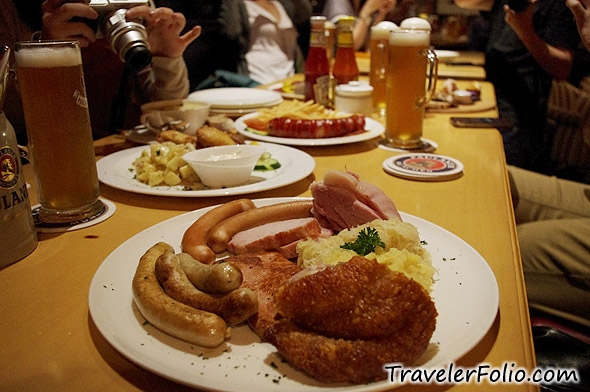
Oktoberfest had viele guten essen; Schweinebraten, Steckerlfisch,  Brezen und wursten (Weisswurst, vor allem),  Knödel, Sauerkraut und Blaukraut. Deutschessen ist sehr lecker und München hat die beste Bier--diese Sommer, ein Junge mir sprach die Beste Bier ist Hofbrauhaus in München. 

Es ist eine glücklich zeit for Deutschland!


(Ich habe Hunger...ich wunsche ich wohne in München.) 


Saturday, May 17, 2014

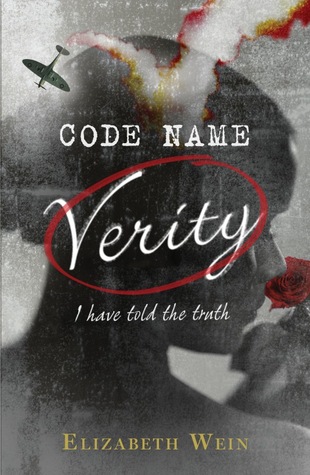
Code Name Verity

There are some books that you like. There are books that you love. There are books that, sometimes, on the rare occasion, you cry over.

And then--once in five blue moons--there's the books that gut you so hard that you can't cry, that you sit facing the wall, rendered completely speechless. The characters still gouge deep in you, and you. Simply. Can't.

This is a WWII book and it isn't. It's a war book and it isn't. It, however, is 100% a friendship story.

Here's a book called Code Name Verity.


Here's the jacket cover summary of the book:

"I have two weeks. You’ll shoot me at the end no matter what I do.

That’s what you do to enemy agents. It’s what we do to enemy agents. But I look at all the dark and twisted roads ahead and cooperation is the easy way out. Possibly the only way out for a girl caught red-handed doing dirty work like mine — and I will do anything, anything, to avoid SS-Hauptsturmführer von Linden interrogating me again.

He has said that I can have as much paper as I need. All I have to do is cough up everything I can remember about the British War Effort. And I’m going to. But the story of how I came to be here starts with my friend Maddie. She is the pilot who flew me into France — an Allied Invasion of Two.

We are a sensational team"


There is a girl. A Scottish spy named Verity, who escaped the night the plane her friend was flying crashed into France. She is caught by the Gestapo. Given a choice: confess everything about the British War Effort, and be given time to write the confession, or be tortured.

She confesses--with the story of how she ended up in the wreckage, the story of Verity and her best friend, the pilot of that plane--Maddie Brodatt.

And what a confession it is. But she's tortured anyway.

What caught me was how beautifully the novel was constructed. The author could have made it dark, depressing, terrifying. She could have emphasized torture and Nazism. And she didn't. Her German interrogators spared her no mercy, but they were far from inhuman, almost comparable to the characters from The Book Thief. But while it spared the reader details, it also managed not to mitigate the darkness of the book. And I have no idea how she did that.

It was also funny. Of course, I'd get asked, "It's a WWII book where a girl gets tortured--how is it funny?" But the main character is Scottish and foul-mouthed, and her Hitler jokes, wrangled into her confession, are simply fabulous. Bonus--I understood every German sentence in that book.

In the end, it wasn't just a WWII story--it was a story of friendship, of a painstakingly-crafted confessions with devastating endings.

Saturday, May 10, 2014

German Updates: Kick-Butt songs

People. People, people.

Today, I have a few awesome songs to share. See, a few days, my German teacher played this one song that basically is playing ON REPEAT on my browser's next tab over.


It's called Pirate, by the German band Kasalla. Basically, these are five awesome dudes from Cologne, singing about....you know, pirates. Could it get any better? 

(Side note: I have the chorus down. Of course, I have close to zero idea what it means--other than "Pirate, wild und frei!"--but I'm blasting it and singing along and trying to stick a Cologne accent down my throat.) 

Which...led me to some other awesome German music. 

A) MORE KASALLA.

Immer Noch Do:


Küm mer lääve:


And after poking around Youtube a little bit, I found another band: Silbermond!

Teil Von Mir:

Here's the thing: I've heard that Germans are quite practical IRL. But when it comes to creativity and art? They're not afraid to let their party animal out. Not to mention that I LOVE their music styles. And though I still don't understand many German songs by lyrics, I still like them. Spanish songs always seemed to be about two things: fiesta, or love (count the times "corazon" is mentioned in a Spanish love song), and I liked them, but I wanted other songs, too. While American songs are dominated by redundant pop songs, German songs are quite refreshing--they're quirky, they're innovative, and they're creative. 

Saturday, April 26, 2014

Southern Y'alls and New York Accents: the German Edition

We know about it here in the States. Down south are the wide Southern accents, the "y'alls" and the wide syllables. I live in Chicago, and a few months ago, at a debate tournament, people from Kentucky commented on my Chicago accent--the narrower words, the nasal tone. There's also the New York accent--the cute curl at the tip of each word, the soft, crisp edges of each sharp syllable.

It's the same in Germany, and in the German-speaking parts of Europe. One from northern Germany may not perfectly understand someone from southern Germany, and someone from east Germany may not understand another from Switzerland.

This video might offer a bit of insight into the different dialects:


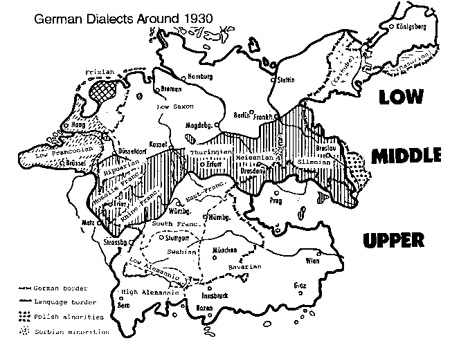
Basically, there are three kinds of German spoken in Germany:
Source: Link

Source: Link

Hochdeutsch: Known as "High German", this is what is generally accepted as the standard German, and the German that is taught to foreigners. It is the language spoken in Southern Germany, around the Alps. Dialects include the Bavarian dialect and parts of the Austrian dialect. S consonants are pronounced like "sch" and Rs are rolled.

Mittledeutsch: Known as "Middle German", this is the dialect that is spoken in central German, around cities like Frankfurt, Cologne, or Dresden.

Niederdeutsch/Plattdeutsch: Known as "Low German", this dialect is usually spoken in northern Germany. (Though Berlin is included, the city is known to speak a form of Hochdeutsch or standard German). S consonants are pronounced like "ss-", instead of "sch-", and Rs may or may not be rolled. "Platt" here refers to the lowlands (which are flat), but I would assume that the dialect here also sounds slightly flatter than Hochdeutsch. Sometimes, the Plattdeutsch dialect has a connotation of being improper, but in most cases it refers to the dialect spoken in Northern Germany.


This interests me-here in the States, usually a Southern accent is noted as being "improper", while the way of speaking in the north is the standard "American English" taught to foreigners. Exactly the opposite of Germany! However, America is not very much known for its diversity of dialects--other than the prominent Southern dialects, the differences between the other American dialects are not quite noticeable. It's almost guaranteed that someone from opposite ends of the country would be able to understand each other perfectly. It also is quite interesting to see how clearly the dialect divides are lined; if only America could be so organized!


Thursday, March 27, 2014

Sometimes I wish I lived in Europe

It's not really a childlike wish as much as it is a contemplative thought.

What is America, you say? Ask any coy European and they have a list to playfully strike you down.

Fat. Cheerful. Overworked burnouts. Rude. Insensitive. Ignorant. Unorganized. Bland.

It's...true. And not.

When I think of culture, I think European before anything else. I think of castles older than my country. I think of sprawling museums with relics of the past, paintings that give a window into what life was long ago. I think impressive architecture, long histories and bloody feuds that sustained between infamous families.

My country doesn't have that kind of feel. America was created to be stripped of bias and tyranny. America is production, not preservation. Individual achievements over community benefit. Making the new, and tossing the old.

Culture? If diversity were a culture...

We are a melting pot. We identify ourselves with nothing that's the same but "American"--and in the loosest sense, it means that our strongest sense of pride is in that one word that our country is named after. That's our strongest link, but by no means a close, communal one.

Europeans have nations, but they also have traditions, and cultures that transcend national barriers. Regional bonds and familial traditions are tighter than any country label they have. Europeans are fond of preservation and history, dedicated to traditions.

Americans don't have an identity; they must make one for themselves.

Yes. Americans can be greedy and materialistic. Americans can be offensive. Americans can be the sweaty, exaggerated, fanny-pack travelers that they Europeans snicker at behind their backs. They may not be graceful explorers.

But keep in mind; next time you see an American huffing and puffing up the narrow stairs to the castletop, or squinting at a Louvre painting, or taking pictures after pictures of the rustic arches of the Roman forum, know that a part of them is trying to seek and capture a beautiful, tangible culture that they long for, but don't have.

Saturday, March 22, 2014

Mozart's Impact

I think there was that Seneca quote that went like, "Life is like a play; it's not the length, but the excellence of acting that matters."

I think that's especially true in the case of Wolfgang Amadeus Mozart.

I don't think this will be an incredibly informative post. It certainly won't be a scholarly analysis of his works, or on specific facts of his life.

Other than this one: he was a brilliant musician. He was a solid genius that managed to pack into his short 35 years of life what others can't attempt  to create in a century.

Mozart's K333 Sonata was the last piece I ever played at a piano competition, you know.

Other people may attempt to pound out his achievements. Because even though I was never good at music competition, I have a good sense for music, and personalities. I want to try to describe the character of Mozart--first, through other composers.

Beethoven (9th symphony) was tempestuous and explosive, Tchaikovsky (Swan Lake & Nutcracker) was illustrious, intricate, and ethereal and Prokofiev (Romeo and Juliet) was ponderous and heavy. Composers were constantly looking to make their "mark"--through a certain music style, or through a manner of composition execution or through their trademark nuances. They wanted a legacy--and being mad genisues, they wanted a dramatic legacy.

Mozart wasn't that.

Mozart is constant, comforting. His music, though not repetitive, certainly creates this straightforward sense of dependability that other music geniuses lack. His pieces have solid, melodies, with perfectly simple, mathematical rhythms that a child could count out. After he gained fame, he didn't succumb to it. He still created the same music he had all his life.

They are not hard to play. But the genius in Mozart's music isn't in the ability to play it. It's in the ability to understand it.

Behind the frills-free sonatas lie an inner musical working that is miraculous and bafflingly straight-laced. Each note has a symbolic meaning; each chord is meant to resonate a certain way.

I loved music, but I hated practicing. I didn't appreciate music until I quit piano a few months ago--and it was then that I realized that all the things my brilliant teacher said--all the meanings behind each embellishment and each --how they contributed to the whole of the creator--the composer.

In the end, Wolfgang Amadeus Mozart let his music speak for himself. In his short life, he still made an enormous legacy for himself.

Try it for yourself. Listen to the composers I listed above, and then listen to Mozart's K333 Sonata. You'll know what I mean.

Chocolate: Belgium vs. Switzerland

Source: http://kitchentalks.com/wp-content/uploads/2011/05/Kitchen-Talks-Swiss-Chocolate.jpg

If there's ONE thing that makes me want to go to central Europe (Germany, Switzerland, Austria, Belgium) more than anything, it's this: the chocolate.

I still remember that time my dad brought a tin of German/Swiss truffles back home. Let's just say that I claimed the box, and it was clean and empty within three days. 

Creamy, was what I thought. It was rich and smooth and velvet that melted on your tongue. There were subtle flavors; hazelnut layering on coffee-hinted dark with just a whiff of vanilla. The outer shells were marvelously crispy, while the insides were heaven to my taste buds. 

(If I'm making you salivate, then I've done my job.)

There's no question; they have the best chocolate in the world.

But what about the best of the best--Belgium and Switzerland? They have quite a chocolate rivalry, but they both boast of proud chocolate histories and special techniques that make the delicious confections taste so spectacular. 

Belgium: 

Taste: Belgian chocolate is known for its quality of the cocoa taste in the chocolate. The flavor is stronger, more brusque, but also more pure. 

Contributions: The Belgians invented the praline in 1912--a man named Jean Neuhaus was credited coming up with the idea that would change the face of the chocolate manufacturing. He would make a chocolate mold (the converteur), and add soft fillings such as cream, nougat, or toffee (there are different flavors--hazelnut is a popular choice.)

Switzerland:  

Taste: Swiss chocolate is known for its smooth, creamy taste--since Switzerland is credited for the invention of milk chocolate, it has perfected the soft texture that melts in your mouth. 

Contributions: The Swiss had many chocolate innovations, but the most important of them came from a man named Daniel Peter. Originally a candle-maker, he switched to chocolate when he was said to have been besotted with the daughter of a chocolate-maker. He began experimenting with chocolate, and eventually ended up with a product known as milk chocolate--something that is so common today that it is unfathomable that the Europeans back then had only dark chocolate to eat. 

Which is better, you ask? 

I don't know, actually. If I ever get to go to Switzerland and Belgium, I will definitely find out for myself. 

But regardless, chocolate is a food that is quite near and dear to my heart, and it's quite cool to learn how two countries dedicate themselves to the innovation of chocolate. To have each person constantly strive to improve the technique of production and the taste--that's what gives European businesses such credibility and uniqueness. Sometimes, when I think of Europe, I think of homey, family-run businesses and individual shops that counter the American mindset of mass-production and major chain industries that, at times, sacrifice identity and quality for convenience. 

Food for thought, isn't it?